
Microsoft Retires the Release Wave Model: What the New “AI at Work” Roadmap Means for Dynamics 365 and Power Platform Users
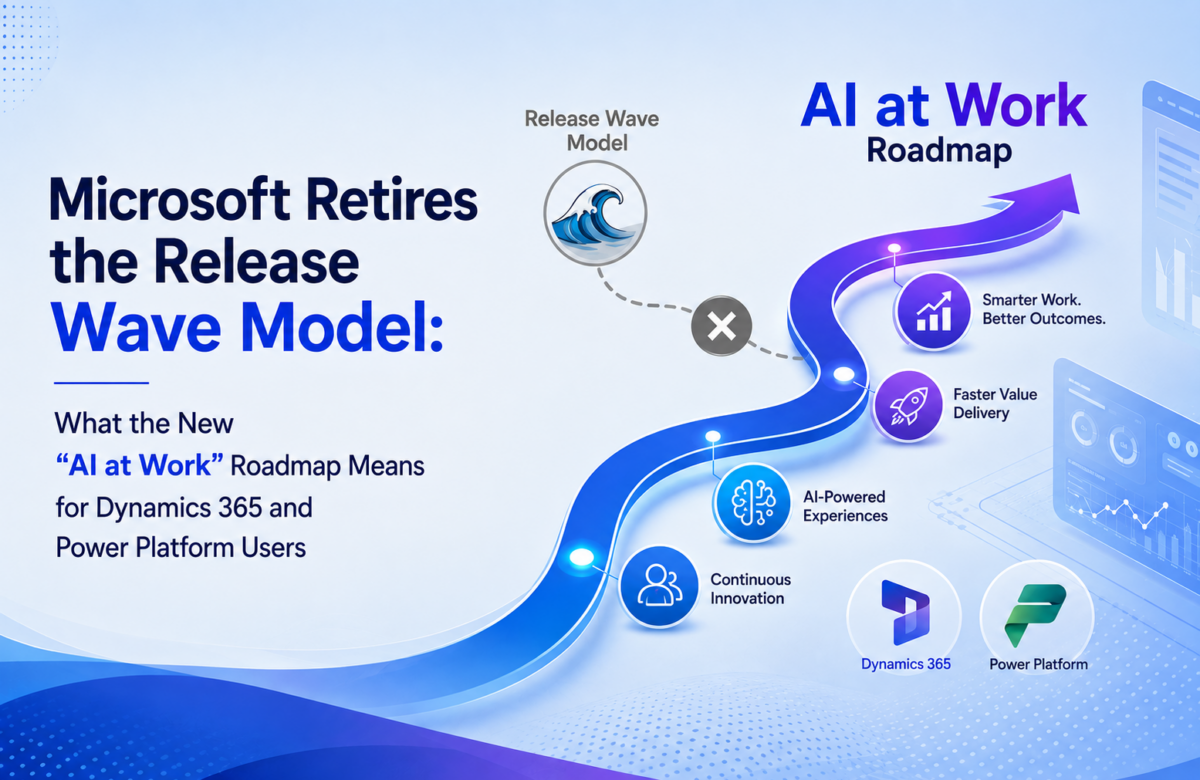
For more than a decade, anyone tracking Microsoft’s business applications had a familiar rhythm to follow: two release waves a year, a Release Planner site, and a predictable cadence of feature announcements for Dynamics 365 and Power Platform. That rhythm is now changing. Microsoft has confirmed it is retiring the release wave structure and folding all future Dynamics 365, Power Platform, and Dataverse product plans into a single, unified destination called the AI at Work roadmap.
This isn’t just a cosmetic shuffle of where announcements live. It reflects how differently organizations now consume Microsoft’s ecosystem rarely as a single, isolated product, and increasingly as an interconnected stack of CRM, ERP, automation, and AI capabilities working together. For businesses running or planning a Dynamics 365 CRM implementation, or scaling out Power Platform solutions across departments, this shift changes how you’ll plan upgrades, budget for change management, and evaluate what’s coming next.
Why Microsoft Retired the Release Wave Approach
Microsoft has used some version of the release wave model since the early 2010s, back when the CRM roadmap still revolved around individual acquisitions and standalone modules. Over time, as Dynamics 365 expanded into a family of interconnected apps Sales, Customer Service, Field Service, Business Central, Finance and Operations and Power Platform grew alongside it, the twice-yearly wave format increasingly struggled to represent how fast individual features were actually shipping.
According to Microsoft General Manager Richard Riley, the company made the change because customers don’t run these tools in isolation. Bringing product plans together into one roadmap lets organizations see everything coming across the stack in a single, filterable view rather than piecing together separate release wave documents for each product line.
The timing tracks with something partners and admins had already been noticing on their own. Industry observers had flagged that updates to the old Release Planner site were slipping behind schedule in recent cycles, which made it harder to trust the wave calendar as a planning tool in the first place. A roadmap that updates on a rolling basis, rather than twice a year, is a direct response to that gap.
What’s Actually Changing
Here’s what businesses and partners should expect as the transition rolls out:
- New capabilities begin publishing to the AI at Work roadmap starting September 2026.
- Existing roadmap content tied to Public Preview or General Availability features originally targeted for June 1 will be migrated by November 2026.
- The Release Planner tool, a mainstay of the old wave system, will be retired on November 15, 2026.
- Roadmap items will now move through three visible phases In Development, Rolling Out, and Launched with status updates reflecting real progress instead of a fixed wave date.
- The new roadmap supports filtering by product and feature ID, CSV export, and RSS subscriptions, and it connects to a Release Communications MCP Server, letting technical teams query roadmap data directly through AI-driven tools and workflows.
Importantly, Microsoft has been clear that this is a change of venue, not a change of substance. Release schedules continue as before, Message Center remains the channel for tenant-specific notices, and Microsoft Learn stays the home for official product documentation.
What This Means for Your CRM and Power Platform Investments
If you’re mid-project on a Dynamics 365 CRM implementation, or planning one for the year ahead, the consolidated roadmap is worth building into your governance process now rather than later. Instead of cross-referencing separate wave documents for Sales, Customer Service, and Customer Insights, your implementation and admin teams can filter a single roadmap by product and track features from early development through general availability in one place. That matters most where AI-driven capabilities Copilot features, agentic workflows, embedded automation span more than one product at once, since a missed dependency between a Dataverse update and a CRM feature that relies on it is exactly the kind of thing a fragmented roadmap used to hide.
The same shift applies on the low-code side. Teams building Power Platform solutions across Power Apps, Power Automate, Power BI, Power Pages, and Copilot Studio have historically tracked platform updates somewhat separately from the Dynamics 365 apps those solutions connect to. With everything on one roadmap, admins and citizen developers get a clearer line of sight into how platform-level changes new connectors, Dataverse enhancements, governance controls line up against the business applications they support, making it easier to plan testing windows before a feature moves from “Rolling Out” to fully “Launched.”
Why the Right Talent Matters More Than Ever
None of that visibility does much good if there’s no one on your team positioned to act on it. Reading a roadmap update is one thing; translating it into a configuration change, a custom plugin, or a governed rollout is another. This is exactly where the decision to hire Dynamics 365 developer talent whether in-house or through a trusted partner starts paying off. Experienced developers can evaluate incoming features against your existing customizations, flag potential conflicts early, and plan upgrades around the new phased status model instead of reacting to surprises.
The same applies on the low-code side. As Power Platform absorbs more AI capability tied directly to the new roadmap, it’s worth the effort to hire power platform developer expertise that understands both the platform’s governance model and how to build solutions that won’t need rework every time a connector or Dataverse feature changes underneath them.
How Vaden Consultancy Helps You Navigate the Shift
At Vaden Consultancy, we track these platform-level changes as part of how we support every engagement not as an afterthought. Whether you’re planning a new rollout, extending an existing CRM environment, or building out automation across your business, our team stays close to Microsoft’s evolving roadmap so your project plans reflect what’s actually coming, not what used to be published twice a year.
If your organization is weighing an upgrade, a fresh Dynamics 365 CRM implementation, or a broader push into Power Platform solutions, this is a good moment to review your roadmap-tracking process alongside your technical resourcing. Our consultants can help you interpret what these changes mean for your specific environment and build a plan that keeps pace with Microsoft’s new cadence.
If you’re not sure whether your current setup can absorb this faster cadence of change or whether your team has the bandwidth to keep up with it that’s a conversation worth having before September’s first wave of updates lands. Reach out to Vaden Consultancy and we’ll walk through your specific Dynamics 365 or Power Platform environment together.
Frequently Asked Questions
What is the AI at Work roadmap?
It’s Microsoft’s new unified roadmap that replaces the old release wave documents. It brings product plans for Dynamics 365, Power Platform, and Dataverse into a single, filterable view instead of separate wave-specific pages for each product line.
When does the change take effect?
New capabilities begin publishing to the AI at Work roadmap starting September 2026. Existing roadmap content tied to Public Preview or General Availability features will be migrated by November 2026, and the old Release Planner tool will be retired on November 15, 2026.
Does this affect how or when Microsoft actually releases features?
No. Microsoft has said this is a change of venue, not a change of substance. Release schedules continue as before, Message Center still handles tenant-specific notices, and Microsoft Learn remains the home for product documentation.
What are the "In Development," "Rolling Out," and "Launched" phases?
These are the three status stages roadmap items now move through on the AI at Work roadmap. They replace the old fixed wave-date system with ongoing status updates that reflect a feature’s real progress at any given time.
How does this affect an ongoing Dynamics 365 CRM implementation?
Instead of tracking separate wave documents for Sales, Customer Service, and Customer Insights, implementation teams can now filter one roadmap by product and follow features from early development through general availability, which makes it easier to plan upgrades and spot cross-product dependencies early.
Does the new roadmap cover Power Platform too?
Yes. Power Apps, Power Automate, Power BI, Power Pages, Copilot Studio, and Dataverse updates all now appear on the same roadmap as Dynamics 365, giving teams building Power Platform solutions a clearer view of how platform changes line up with the business applications they connect to.
Can I still export or subscribe to roadmap updates?
Yes. The AI at Work roadmap supports filtering by product and feature ID, CSV export, and RSS subscriptions, and it connects to a Release Communications MCP Server for querying roadmap data through AI-driven tools
Should my organization change how it plans for Microsoft updates?
It’s worth reviewing your update-tracking process either way. A faster, rolling-status roadmap rewards teams that check in regularly rather than twice a year — which is also a good moment to assess whether your in-house team or partner has the bandwidth to act on changes as they roll out.
Follow VADEN Consultancy on LinkedIn for more insights on Microsoft Dynamics 365, Business Central, Power Platform, Power BI, AI, Azure Cloud, CRM, ERP, automation, cybersecurity, and business technology.